Sunday, June 23, 2019

Cinnamon Roll 3D Cinnamon

Lorem ipsum dolor sit amet, a mark here adipisicing elit. Atque, iusto, minus sequi natus nesciunt rerum tenetur corrupti autem officiis fugiat expedita laudantium ea aspernatur Lorem ipsum dolor sit amet, consectetur adipisicing elit. Nam, velit, facere eos molestias rerum nesciunt consequatur voluptate minus quod Lorem ipsum dolor sit amet, consectetur adipisicing elit. Odio, vitae, dolore, ratione, neque deleniti officia atque dignissimos porro. Consectetur adipisicing elit. Corrupti, aliquam, voluptates, nulla, blanditiis totam voluptatem voluptatum quod ipsa debitis non ab odio natus.

Quisquam, dolorum, iusto iste voluptates rerum ea quas expedita.

Lorem ipsum dolor sit amet, consectetur adipisicing elit. Omnis et ullam libero repellendus voluptatibus obcaecati magni id nulla dolores nesciunt. Quasi quisquam facilis nobis ullam rem deleniti vero consectetur earum.

Lorem ipsum dolor sit amet, consectetur adipiscing elit. Integer posuere erat a ante.
Someone famous in Source Title
Lorem ipsum dolor sit amet, consectetur adipiscing elit. Proin eleifend dolor massa, nec adipiscing massa accumsan vel. Nunc pulvinar nisl ac justo consectetur, fringilla feugiat eros ultricies. Sed eu tellus ipsum. Duis ornare euismod felis non sodales. Integer a nisl eros. Nunc ultrices risus urna, et facilisis massa tristique et. Sed mi libero, faucibus vitae sollicitudin sed, volutpat et quam.

Etiam pretium lobortis enim. Nunc at semper felis, ultrices adipiscing tortor. Nulla facilisi. Etiam nec imperdiet nunc. Pellentesque nec blandit turpis. Quisque pulvinar dolor in nunc accumsan tristique. Donec eleifend dolor condimentum condimentum sodales. In volutpat imperdiet posuere. Aenean feugiat ut tellus et eleifend. Aliquam erat volutpat.

Nullam eu dolor ac ipsum adipiscing pellentesque. Praesent pulvinar quis nisl eu porta. Sed eget varius mi. In malesuada posuere mauris, id porttitor orci consequat vestibulum. Sed ultricies arcu eget ligula convallis, vel condimentum augue ultrices. Duis quis diam et justo interdum tristique. Donec tempor velit a egestas ullamcorper. In vel fringilla tortor. Donec tempor metus lacus, eget vulputate sapien feugiat in. Aliquam vel metus vel dui fringilla viverra. Aenean et dapibus erat. In imperdiet volutpat libero, eu posuere tortor imperdiet in. Morbi nec turpis velit. Etiam ultrices, enim at gravida tincidunt, lacus tellus tincidunt nunc, sit amet bibendum erat libero porta magna. Maecenas neque erat, sagittis quis mauris a, pulvinar rutrum metus. Cras dignissim pharetra felis, vitae aliquet augue consectetur quis.

Friday, May 3, 2019

The Darksome Bounds of a Failing World by Gareth Russell – review


The Titanic as a metaphor that has rattled down the ages ... does this book work as a morality tale about the collapse of a slipshod civilisation?
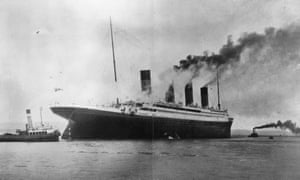
The Titanic.
 Deathtrap and metaphor … The Titanic. Photograph: Topical Press Agency/Getty Images
The story of the Titanic has been retold so often, most frequently during 2012 when the centenary of its capsizing rolled around, that it is hard to see why it would need to be done again. But perhaps that is to miss the point of Gareth Russell’s book. People who consume one thing about the Titanic tend to consume many, and there is always a shivery pleasure in accompanying old friends as they climb aboard once more, unaware that they are walking not only into a deathtrap but into a metaphor that will rattle down the ages.
In stateroom C-77 is the Countess of Rothes, the public-spirited British aristocrat who is on her way to join her husband in the US, where they will celebrate their 12th wedding anniversary. Along the corridor, in C-55 and C-57 are Isidor and Ida Straus, a devoted couple who touchingly – and vulgarly, according to the way these things are usually done in the “best circles” – choose to sleep in a double bed. They are on their way home to Macy’s, which Isidor owns, having spent the winter weeks warming their ancient bones in the south of France. One floor down, on B deck, is 47-year-old John Jacob Astor IV, the richest man on board if not in the world, who has scandalously married Madeleine Fiermonte, aged 17, now five months pregnant. Also slinking around the first-class quarters is J Bruce Ismay, the son of the founder of the White Star Line, which owns RMS Titanic. No one can stand him. It’s not that Ismay has done anything demonstrably wrong at this point – that will come later, when people start whispering about how he has managed to survive the sinking while so many other men go down. It’s just that he has an uncanny ability to misread social situations, barging into conversations that don’t concern him, and generally creeping out everyone on board, especially the ladies.
It is fun too to wander once more through the Titanic’s preposterous interior. The writing room is late Georgian, the lounge is Louis XV and the dining room has nods to Hatfield House, Elizabeth I’s childhood home. The tapestries are vaguely medieval but there’s also an unlikely smattering of cottagey pebbledash. You do, though, need to manage your expectations if you’ve got one of the cheaper first-class cabins: many of them don’t have their own lavatories, which means you’ll have to scuttle along the corridor to find the nearest shared convenience. There is no dressing for dinner on the first night, and you can’t just barge into the smoking room if you fancy a fag – it’s strictly men only. And don’t, just don’t, ask if you can have a tour of the third-class accommodation to check that the people in steerage are comfortable. At least one Lady Bountiful has attempted this version of maritime poor-visiting, and it went down badly. You can almost feel Julian Fellowes, who has done the cover blurb for Russell’s book, shuddering with embarrassment at someone so posh getting it so wrong.
Leonardo DiCaprio and Kate Winslet in the 1997 blockbuster The Titanic.
Pinterest
 Preposterous interiors … Leonardo DiCaprio and Kate Winslet in the 1997 blockbuster The Titanic.
In truth it is hard to see what Russell adds to a story that has been worn smooth by a century’s worth of popular histories, Hollywood blockbusters and TV documentaries with terrific underwater footage. Even his decision to concentrate on a cluster of individual passengers has been done before by Richard Davenport-Hines in his excellent Titanic Lives. Russell’s variation on this methodology is to spend much longer on his travellers’ backstories in the hope that, plaited together, the result will be something like a synoptic account of the 20th century in its debutante days. So a section on Dorothy Gibson, a silent movie star travelling with her mother in cabin E-22, gives Russell a chance to retell the story of America’s early film industry, which is located not in California but New Jersey. Then there’s the Macy’s owner Isidor Straus, whose immigration as a nine-year-old from Bavaria to Georgia in 1854 pitches Russell into a long digression about patterns of slave-holding amongst Jewish families in the antebellum south.
Russell doesn’t stop there though. He projects the tale of his voyagers forwards too, so for instance we learn that Dorothy Gibson, who relocated to Europe in the 1920s, has an ill-advised flirtation with fascism, which nonetheless leads to her imprisonment by the Nazis in 1944. By contrast, the Countess of Rothes, who proves herself an absolute brick in one of the lifeboats, pursues a post-Titanic life of strenuous philanthropy, having discovered, she says somewhat ominously, that it is the best way she knows to be happy.
In principle there is nothing wrong with wrenching the Titanic away from its frozen moment and restoring it to the ebb and flow of ordinary time. The problem is that this isn’t what Russell really wants to do. As his portentous title suggests, he is in the business of making the Titanic story huge and metaphorical, a morality tale about the collapse of a somewhat slipshod civilisation. The result is as unconvincing as the ship’s haphazard interior, a pile-up of the gaudy and the mundane.
 The Darksome Bounds of a Failing World is published by William Collins (£25). To order a copy go to guardianbookshop.com. Free UK p&p on all online orders over £15.

Since you’re here…

… we have a small favour to ask. More people are reading and supporting our independent, investigative reporting than ever before. And unlike many news organisations, we have chosen an approach that allows us to keep our journalism accessible to all, regardless of where they live or what they can afford.
The Guardian is editorially independent, meaning we set our own agenda. Our journalism is free from commercial bias and not influenced by billionaire owners, politicians or shareholders. No one edits our editor. No one steers our opinion. This is important as it enables us to give a voice to those less heard, challenge the powerful and hold them to account. It’s what makes us different to so many others in the media, at a time when factual, honest reporting is critical.
Every contribution we receive from readers like you, big or small, goes directly into funding our journalism. This support enables us to keep working as we do – but we must maintain and build on it for every year to come.

Sonic the Hedgehog movie to be redesigned after criticism of trailer


Director thanks fans who objected to the appearance of the video game character and assures them it will be modified
Sonic the Hedgehog as he appears in the trailer for the forthcoming movie.
 Under fire … Sonic the Hedgehog as he appears in the trailer for the forthcoming movie. Photograph: Paramount Pictures

Sonic the Hedgehog director Jeff Fowler has announced that “changes” will be made to the forthcoming movie based on the video game after the trailer premiere was met with blistering criticism.


The three-minute trailer, featuring star Jim Carrey as Dr Eggman alongside the CGI-animated hedgehog, debuted on Tuesday, and was greeted with considerable derision. The Guardian’s Keith Stuart described it as “a 200mph slap in the face” and said the central character “resembles a cheap knock-off Sonic toy your child might win at a fairground stand and then be terrified of”. The character’s human-style teeth drew particular flak on social media.

 Paramount Pictures' Sonic the Hedgehog - trailer

Using the hashtag #gottafixfast, Fowler – a VFX specialist whose previously worked on Spike Jonze’s adaptation of Where the Wild Things Are – posted a message on social media saying: “Thank you for the support. And the criticism. The message is loud and clear... you aren’t happy with the design & you want changes. It’s going to happen.”
Sonic the Hedgehog has been in development as a movie since Hollywood studio Sony acquired the adaptation rights in 2013. However, it failed to get a project off the ground, and the rights passed to Paramount in 2017. The film is due for release in November.

Hope and heart: emotions stirred in Liverpool at season's crescendo

Three weeks ago, amid a gripping Premier League title race, Phil Scraton and Margaret Aspinall walked into a room at Melwood, Liverpool’s training ground, to talk to a squad of multimillionaire footballers about the 30th anniversary of the Hillsborough tragedy. Scraton turned 70 this Friday and, despite his vast experience of life and injustice, of joy and horror, he felt anxious. His support of Liverpool stretches over 60 years. From the days of Billy Liddell, a star when the club were still in the old second division, to Liverpool’s domination of English football under Bill Shankly, Bob Paisley and Joe Fagan, and throughout the current 29-year wait for another league title, Scraton has been a fan.
In the silence he looked at the small sea of faces and picked out players he reveres now, from Mo Salah and Virgil van Dijk to Andy Robertson and Trent Alexander-Arnold. Scraton was unsure how they would react to him remembering a catastrophe that occurred before any of that quartet was born. His work as an academic and criminologist, as the man who did more than anyone to expose the institutional deceit that hid the truth of why 96 Liverpool fans died at Hillsborough, suddenly mattered little. Scraton wondered if this group of title-chasing footballers might yawn or sigh.


Aspinall had lost her 18-year-old son, James, in the terrible crush on 15 April 1989 and, as always, she offered strength. She helped Scraton talk in his compelling way.
“I found myself in a whirlpool of very affluent young men who come from all backgrounds, some of them from war zones,” he says. “They are anything but overpaid egotists. They were humble. They were very respectful. Not only of me – and I’m nobody really – but of Margaret. The fact they were so visibly moved, during the most important run-in of their careers, showed real humility. No one had a mobile phone in sight. There was not a moment’s distraction – just an absolute focus on understanding Hillsborough.
“I spoke about the fact that 96 has been stitched into the neckline of their Liverpool shirt. I said: ‘You carry that with you every time you step on to the field. This isn’t about football. This is about respect and bereavement. This is about understanding families and Liverpool itself.’

Phil Scraton, critical criminologist, academic and author. He is a social researcher, known particularly for his investigative work into the context, circumstances and aftermath of the 1989 Hillsborough disaster. More recently, he was a member of the Hillsborough Independent Panel and headed its research,

  • Phil Scraton, critical criminologist, academic and author. He is a social researcher, known particularly for his investigative work into the context, circumstances and aftermath of the 1989 Hillsborough disaster. More recently, he was a member of the Hillsborough Independent Panel. Photograph: Patrick Bolger/The Guardian
“I’m convinced they thought about everything – including their own lives. They’re human beings first, footballers second. They take responsibility. How many have we seen setting up trusts or schools in their homelands? This is a new era. This is identifying a totally different frame of reference that, with fame and money, comes social responsibility. Manchester City have Raheem Sterling. Many Liverpool fans have despised Sterling because he left us for City. But he’s surpassed all that with his stance against racism. Fans on the Kop, or anywhere, see footballers now who take responsibility sincerely.”
A few days after he met the players Scraton went to Anfield. Before Liverpool beat Chelsea 2-0 to sustain the dream they might become league champions for the first time since 1990, the Kop unfurled a “SCOUSE SAINT SCRATON” banner in honour of everything he did in leading the long campaign to win justice for the 96.


The banner moved Scraton to tears the first time he saw it but he prefers to stress now that: “Jürgen Klopp and Pep Guardiola understand the legacy of their clubs intellectually. They grasp the significance of their role in football and as members of a community. There is no coincidence they are battling it out at the top of the league. They don’t get into silly arguments with each other. They mean it when they congratulate another team. It feels like a new era.”
It felt different two nights earlier when, in a crammed bar in Liverpool, I watched Manchester United play City. Trailing Liverpool by two points, City’s title defence was examined again. It was goalless at half-time and, as Liverpool’s hopes grew and they urged on United, their bitterest rivals, one fan kept yelling: “Oh, you fuckers … oh, you fuckers!”, whether Jesse Lingard missed a chance or a crumbling defence allowed City to score twice and go top again.
Their lead would last 48 hours before Liverpool moved two points ahead again. Last Sunday, as City played their game in hand, there was renewed hope that a winning run of 11 consecutive league wins would end at Burnley. But Guardiola’s team won again to edge ahead, as the lead changed hands for the 30th time, with both teams now having two games left.
On Saturday night, as his side face their penultimate test away to Newcastle, Scraton will wear his Liverpool shirt at home as he feels the familiar mix of hope and apprehension. Newcastle, under Rafa Benítez, will be even more difficult now. After Liverpool’s 3-0 loss away to Barcelona this week, with Lionel Messi’s genius blowing them off course, the likelihood is their magnificent season will end without a trophy to celebrate such progress on and off the field. However, when asked about his slim hopes of the title, Scraton sounds sanguine.
“It will be a great football accomplishment and a real thrill to see a team built on the right principles become champions. And there is a certain resonance if they don’t win it, of coming so close in the 30th anniversary of Hillsborough. But to conflate the suffering of survivors and families with the sheer thrill of winning a title, denies the serious reality of Hillsborough.”

The memorial for the Hillsborough disaster victims underneath the main stand at Anfield.

  • The memorial for the Hillsborough disaster victims at Anfield.
The longer I spend in Liverpool the more I sense this is not just a bittersweet cliffhanger of a title race. Something deeper is stirring in a great old club which believes itself capable, again, of mounting sustained title and Champions League challenges every season. Of course many rival fans hate Liverpool and it is easy to understand why when there is a huge mural of Klopp in the city’s Baltic Triangle. Klopp has a hand over his heart alongside a slogan: “We are Liverpool. This means more.”
Setting aside the failure to explain the exact meaning of “This”, many opposition fans will be offended by the claim football means more to Liverpool. But, even as a supporter of a different club, I have felt Liverpool’s emotion. It’s not just that they may end up with 97 points, having lost one game, and finish behind the City juggernaut. It’s not just Hillsborough that runs through this story like a deeply moving current. It’s not just Klopp, or the Kop, or the fervour as Liverpool’s longing to be champions ebbs and flows.

A mural of Liverpool manager Jurgen Klopp by the street artist “Akse” on the corner of Jordan and Jamaica Street in the Baltic Triangle area.

  • A mural of Jürgen Klopp by street artist ‘Akse’ on the corner of Jordan and Jamaica Street in the Baltic Triangle area.
Scraton describes a chance meeting he had with Robertson, one of Liverpool’s best players this season. “I went up to Andy Robertson after a game last year. He was with his family, his new baby girl in a pushchair. I said: ‘Andy, you don’t know me, but I wanted to say you give me great pleasure. It’s incredible to see how your hard work and talent has allowed you to break through in an era where we’re thinking we might need to spend £100m to get our next great player. Nothing has given me so much pleasure as watching you.’
“Andy looked up very shyly and said: ‘Thank you so much for that.’ I was thinking: ‘This is a guy who just 18 months earlier was at Hull.’”
It matters to Scraton that, when I interviewed Robertson last year, the Scot asked me to downplay his laudable work with foodbanks as he did not want it to look like he was seeking publicity for showing ordinary decency. The same spirit underpins Van Dijk’s preference not to talk about the help he and his wife give to impoverished local children. They have counterparts at City, such as Vincent Kompany and Sterling, and Scraton sees humanity before football in this topsy-turvy title battle. “All the corporate responsibilities and deals have soured the Premier League. But this season it’s felt like we’re getting to a new place where personal and social responsibility is taken. I don’t want to wax too lyrically because Liverpool and City are giant corporations. So much of football is underpinned by agents and corporate bodies which have tentacles wherever they can promote self-interest.
“But Liverpool are saying: ‘We’re not going to lose sight of the fact this is also people’s passion.’ It’s getting that balance between the bankers and rip-off merchants and the belief of those who truly support the game. I honestly believe we have this realisation that big economic gain brings community-based responsibility. Any club which denies that will be left behind. Klopp gets it. Guardiola gets it. Van Dijk, Salah, Robertson and all those young men I met get it. Sterling gets it. Look at his very strong gesture in paying for all those children from his old school to go to a match at Wembley. In the same breath he uses his position to condemn racism. That make this title race feel like a new era.”


Alexander-Arnold is 50 years younger than Scraton. He is only 20 but, alongside Robertson and Van Dijk, he helps Liverpool supply three of the four defenders in the PFA’s Premier League team of the season. After training at Melwood he nods intently when I ask whether he had been touched by Scraton’s talk. “Massively. We’d never come close to hearing them sorts of stories, and what it must have been like for the families on that tragic day. It was good they were able to educate the players because it’s important we know why that number is on our shirt. We’re playing in memory of those 96, and everyone involved in Hillsborough.”
Alexander-Arnold, who grew up in nearby West Derby, talks earnestly. “We were brought up to know there were always people less fortunate than us. Now, with me being in this very privileged position, I can give back to the community more than someone my age usually can. That keeps you humble and grounded. Going out into the community gives you that sense of normality, and a connection with the city, you never want to lose.”
He remembers his first taste of glory when he was six years old in 2005 and the bus carrying Liverpool’s Champions League-winning squad drove past his home. “That was my first football memory so it was like: ‘This is normal,’” he says with a grin. “But you realise what happened that year was very special.
“The bus went straight past my house, and me and my mates were on different garden walls. Seeing the players and this trophy was incredible. Hopefully we’ll recreate that and bring a sense of joy back to Liverpool with some major silverware.”
Little Trent would walk to Melwood in the hope he might see his heroes. “It took me 10 minutes to get here and you wanted to see Steven Gerrard and Jamie Carragher. They were local players I idolised. I wanted to be a Liverpool football player and I wanted to see what it was like to be one. Any opportunity I got I’d peek at them through the gates and the cracks in the walls at Melwood. Now it’s strange that kids from round here are looking at me. It shows us, as players, that we’re doing something right.”

Trent Alexander-Arnold warms up before Liverpool’s Premier League match against Huddersfield at Anfield in April 2019.

  • Trent Alexander-Arnold warms up before Liverpool’s Premier League match against Huddersfield.
The last time Liverpool came close to ending their title drought, in 2014, Alexander-Arnold was 15. Of course Gerrard, the saviour of Liverpool for so many years, slipped against Chelsea. Demba Ba scored and Liverpool’s dream died for another year. Alexander-Arnold grimaces when I ask if he was at Anfield that day. “I went to every home game. It was a very special season but the slip was tough. I was more gutted after the Crystal Palace game [which Liverpool drew after being 3-0 up]. That finished it. But it’s helped us this season in terms of the fans not getting too excited too early. We got carried away in 2014 and felt like we’d won it. Especially after that City game [which Liverpool won 3-2] everyone assumed we’d be champions. But it’s important the fans have that reality and understand that anything can happen. It’s helped us to keep going until the very last game.”
Towards the end of his playing career Gerrard coached Alexander-Arnold at Liverpool’s academy. I remember how, while he relived the anguish of his slip in unsparing detail when we worked on his autobiography a year later, Gerrard found relief in Alexander-Arnold’s shimmering promise. Did he ever ask Gerrard about that game?


“No. It was too fresh for him to speak openly about it. Obviously, being 16, we weren’t in any position to ask him about it. I don’t think anyone can really understand the pain he felt, as not winning the league was one of his biggest regrets. Hopefully we’ll still do it and he’ll watch it, and be proud of us, with a smile on his face.”
How has he coped with such a tense title race? “Our mentality is not to get caught up overthinking. It’s focusing on ourselves and putting pressure on City. Hopefully one of these last teams will take points from them. But it’s important to enjoy it, to embrace it as much as we can.”
Alexander-Arnold pauses when asked what it would mean to him to win the league. “I’m struggling to find the words,” he eventually says, “but it would be an incredibly proud feeling to be the first team to do it in 29 years. I think that sense of accomplishment will lead to other titles and the Champions League. That’s the main thing for us – getting some silverware on board. That would be the start. If we win the Premier League we sense the floodgates will open.”

Fans on the Kop sing You’ll Never Walk Alone before Liverpool’s Premier League match against Huddersfield at Anfield in April 2019.

  • Fans on the Kop sing You’ll Never Walk Alone before Liverpool’s match against Huddersfield.
The regeneration of Liverpool is seen most obviously along the waterfront, near Albert Dock. This is Liverpool One, where new offices and beautifully restored buildings stand alongside hotels and restaurants which are heaving on match days with supporters from across the world. But the distinct character of Liverpool remains and there are reminders this is not a one-club city. Everton have opened a shop in the heart of Liverpool One. It is called Everton Two.

Liverpool fans pass by the Everton shop called 'Everton Two' in the Liverpool One shopping centre.

  • Liverpool fans pass by ‘Everton Two’ in the Liverpool One shopping centre.
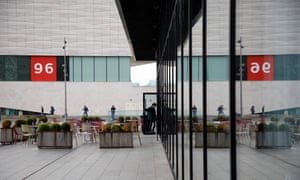
On the waterfront, outside the gleaming Museum of Liverpool, a sombre image evokes a different history. 96 is etched in white and set against Liverpool red. Framed by black glass, this starkly moving memorial shows how deeply Hillsborough is etched into Liverpool – in a vibrant area where the stylish offices of the Anfield Wrap are found.
An award-winning podcast and website, the Anfield Wrap has grown from broadcasting one free show a week in 2011 into a thriving business that employs 10 people full-time and produces around 14 audio episodes and 11 video presentations weekly. When Liverpool are flying, downloads exceed 80,000. A measure of the Anfield Wrap’s success, and its ability to monetise fandom, is found in the fact six staff members were in Barcelona this Monday to Thursday, working and drinking while producing podcasts and articles.


Neil Atkinson, their main presenter and co-founder, is bullish at 8am in his office. “It’s not bittersweet until the end,” he insists when asked if he has begun to succumb to a poignant feeling of what might have been if Liverpool had been competing against anyone but Manchester City. “The only way this can go badly wrong would be if we dropped points in any of the remaining games. That would hurt. It’s so important to make 97 points. Even if they don’t manage to win the title it means they had a task and followed it through until the end. The second thing is that in order to take the opportunity for your luck to come at the last moment, you must push to the very end. We need to be lucky because Manchester City are absolutely brilliant. We can only hope someone hangs on to a draw against them. So it’s not bittersweet yet. We’re going this weekend and to feel bittersweet would be really sad. How can it be sad watching the best Liverpool side you’ve ever seen?”
Atkinson is 38 and has supported Liverpool since the first game he saw in April 1986, when a 5-0 hammering of Birmingham City included a surreal Gary Gillespie hat-trick. He watched them win the league in 1988 and 1990. Considering the global reach of the club and the Anfield Wrap, Atkinson says, “You cannot call overseas Liverpool supporters glory hunters. We’ve won one trophy this decade. If they’re glory hunters, they’re really bad ones. They’re actually journey hunters. It’s the journey and the story. Something about Liverpool has grabbed them. There will be people coming from all over the world who won’t have a ticket for the last game of the season. They want to be at the party if it comes off. It opens up Liverpool to the world in a really inclusive way.”
Atkinson suggests Liverpool want to be “adored” – a sentiment that does not sit easily with many on Merseyside or with rival fans. “That’s the difference between us and Man United,” he says. “Their supporters want that ‘hated, adored, never ignored’ feeling. Man United don’t care whether you like them. This is one of the differences between the cities. You can make a crisper comparison between Liverpool and United because City are somewhere in the middle of this. I think there’s this desire among the hierarchy of Man City and their fans that the country should bow down to how brilliant they are, not least because they are brilliant.


“In Liverpool we act as though we’ll do our own thing, but we want you to think our thing’s brilliant. There’s a ‘come and adore us’ thing here. We want visitors to say: ‘Liverpool was good, Liverpool was friendly, Liverpool was great.’”
He makes it sound like a lingering insecurity? “That’s definitely true. But I wouldn’t call it insecurity. Liverpool’s too good at being secure at being Liverpool. It’s more a neediness. We want the adoration. That’s something I’m fine with because wanting to be liked for the right reasons is no bad thing. What Liverpool won’t do is change in order to be liked. It wants to be liked by virtue of its Liverpool-ness. It makes it a more unpredictable, bouncier place than Manchester. Manchester needs to be its stoic, solid, economic-heartland-of-the-north self. It suits Liverpool to be more creative, more outward-looking.”

Craig Hannon (left), head of marketing and Neil Atkinson, the host of the Anfield Wrap podcast, in the audio recording studio of their office in the Waterfront area.

  • Craig Hannon (left), head of marketing and Neil Atkinson, host of the Anfield Wrap podcast, in the recording studio of their office in the waterfront area.
Atkinson’s faith in Klopp is unwavering. “Klopp turned up in English football, knowing Guardiola’s on his way to City. Every decision Klopp’s made, from recruitment to the way he’s carried himself, says he knows Liverpool need 100 points to become champions. That’s in stark contrast to the decisions made by United, Chelsea and Arsenal the last three seasons. Klopp saw the coming threat of Guardiola and planned accordingly. Tottenham had an awareness of it because Pochettino’s not daft, but they operate in a different sphere. At the start of the 2016-17 season, if you asked Klopp: ‘How do you win this league?’ I think his honest view would’ve been: ‘We need 95+ points.’
“Now, if you’re Salah, Firmino, Mané, Fabinho, Van Dijk or Alisson you can achieve all your ambitions with Liverpool. This is the first time that’s felt the case. It’s gone from the idea of Liverpool as the last stepping stone to a mega club, to Liverpool being as good as anywhere. That’s why 97 points is so important. You can say to players, both current and prospective: ‘Liverpool take everything to the last game.’
Craig Hannan, the Anfield Wrap’s head of marketing, is 28 and so he was born after Liverpool last won the title. “If you think about the things that have happened since then it’s incredible,” he says. “We’ve had the start of the Premier League, Blackburn winning the title, Wenger, Arsenal’s Invincibles, the domination of United, the rise of City …”


Hannan laughs when I list some of the global events that had yet to happen when Liverpool were last champions – the Berlin Wall had not been torn down, apartheid had yet to end and the internet was still an unknown word to most of us. “That’s why it’s a travesty Liverpool haven’t won the league in 29 years. I’ve heard people say that we would be unbearable if we won. But we don’t want to be hated. We love the idea that at the end of the season, people might say: ‘Liverpool played some lovely football, and they’ve beaten the best side that’s possibly walked the Premier League.’ It would be amazing.”
The Anfield Wrap is a minute’s walk from the office of Steve Rotheram, the former Labour MP and now the city’s metro mayor. His view is panoramic and, from here, the rise of Liverpool in economic and cultural terms is clear. It was very different when the 57-year-old was a boy.
“We were eight kids,” Rotheram says. “My dad used to get his wages and half would go to my mum for the household, and half to the Labour club and his alcohol consumption. We didn’t feel poor because everybody was the same. But to squeeze out some money to go to Anfield I developed a cunning technique. I’d ask my mum because she’d always say: ‘If you can get half from your dad I’ll give you the rest.’ So I’d go to my dad and say: ‘Mum’s given me half but it’s not enough.’ He loved football so he’d give it to me.
“He wasn’t an affectionate man. The only time I ever got a fatherly hug was after the 1971 FA Cup final against Arsenal. We got beat by Charlie George’s famous goal. I cried my eyes out in the back garden. I’ve never forgotten it because he actually showed some affection to me. He also said something quite wise: ‘You’re of an age where you will see Liverpool dominate football. We’ve got the best manager [Shankly] in the world now.’ He actually gave me a hug.”

Steve Rotheram, the Metro Mayor for Liverpool in his office overlooking the waterfront area.
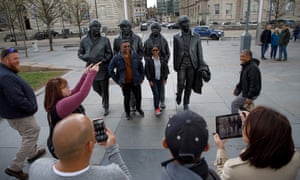
Tourists pose for pictures next to the statue of The Beatles in the Waterfront area.
A sign indicating the number of lives lost in the Hillsborough disaster on the side of the Museum of Liverpool.
The waterfront area of Liverpool with the Museum of Liverpool, Liver Building and Mann Island buildings.

  • Steve Rotheram, the Metro Mayor for Liverpool in his office overlooking the waterfront area; tourists pose for pictures next to the statue of The Beatles; a sign indicating the number of lives lost in the Hillsborough disaster on the side of the Museum of Liverpool; the waterfront area of Liverpool; Liver Building and Mann Island buildings.
Liverpool won the league 11 times over the next 19 years. Their 18 league titles are bracketed with five European Cups and seven FA Cups. As a young man Rotheram must have been blase about such success? “Absolutely. If we didn’t win it one year I knew we’d win it the next. But, after Hillsborough, I stopped going for 18 months. I couldn’t face football.”
Rotheram had been at Hillsborough and, shortly before kick-off, he’d swapped his ticket in the doomed Leppings Lane end. “It was one of those quirks of fate,” he says, his face clouding. “Outside the ground we were jammed together. Three lads were talking and one asked me where I was sitting. I had a ticket for Leppings Lane. He said: ‘I’ve got one for the stand so, if you want it, let’s swap.’ I gave him my Leppings Lane ticket because that’s where the two other lads were heading. I went left and they headed down the tunnel …”
Rotheram’s voice trails away. Does he know what happened to them? “No. That’s one of the things you think about. You suffered trauma even if you survived.”
The death of 96 people was exacerbated by the lies of the Sun and the determination of the police and many politicians to distort the truth for decades. “I felt huge frustration,” Rotheram says. “I was a bricklayer at the time so I didn’t feel there was any way I could dissuade people from their wrong-mindedness. We tried to redress the imbalance in small ways. If we met supporters of other teams we’d explain what happened. If they’d been to Sheffield they knew what we were saying.”


Rotheram reiterates how much football, and society, owes to Scraton and the Hillsborough families. His mood soon brightens again when asked to explain the impact of Liverpool, as a club, on his city today. “You see it on match days and it’s wonderful to look at fans arriving from all over. Have you seen the report on how the city makes half a billion quid a year from Liverpool football club?”
The boom the city will experience when, one day, Liverpool finally win the league again will feel profound. But Rotheram is anxious. “Klopp has my undying love, and he’s brilliant, but he hasn’t won anything yet. Sometimes you just need to win something. I don’t care if it’s the League Cup. I just want to see us lift something and start again.”
What does Rotheram think of the “This means more” posters? “It’s brilliant, and it encapsulates our spirit. When you think how battered we were as a city it’s uplifting how we stick together. That solidarity flows through Liverpool in a way that is not quite the same in other places.”

Liverpool fans arrive at Anfield last Friday.

  • Liverpool fans arrive at Anfield last Friday.
Fans of Everton and Newcastle, United and City, Tottenham and Palace, and most other clubs will insist football means just as much to them as it does to Liverpool. But, after Heysel and Hillsborough, after 29 years without a league title, it’s possible to feel sympathy that a staggeringly consistent season for Liverpool may end without a trophy.
“There might be one more twist in the tail,” Rotheram says hopefully.
If Liverpool can beat Newcastle and Benítez, the tactical old fox, maybe another of their former managers, Brendan Rodgers at Leicester, will stop City?
“Perhaps,” Rotheram says, smiling sadly.
Is he concerned how Liverpool will lift themselves next season if 97 points is not enough this time? “Yeah, I am. The shining light is we’ve got a manager who can put whatever happens right. I’m sure he’ll get them going again. The hard thing to take is that, almost any other year, we would have already won it with three games to play.”
That third last league game of the season was against Huddersfield last Friday. Walking down Utting Avenue to Anfield, three hours before kick-off, the Reds were not yet out in force. They were outnumbered by the advertising slogans proclaiming that this means more to Liverpool – and posters where the word “Dream” was crossed out and replaced by “Believe”. The same campaign has an X running through “Stadium” so it can be called “Home” while “Songs” is crossed out in favour of “Anthem”.
They might just be soundbites but they chime with how this club sees itself. Yet, before Liverpool thrashed Huddersfield, scoring their first goal after 15 seconds, realism was also at work. When the team coach rolled into Anfield 90 minutes before kick-off only a few red flares were lit. The chanting and clapping was muted rather than the roaring cacophony that surrounded every Liverpool home game towards the end of the 2013-14 season.

Fans arriving outside the Kop before the Liverpool v Huddersfield Premier League match at Anfield in April 2019.
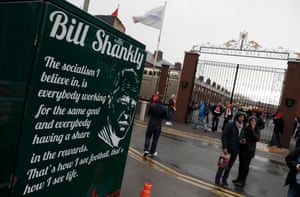
Fans gather round the Shankly Gates before the Liverpool v Huddersfield Premier League match at Anfield in April 2019.
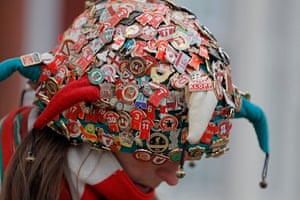
A fan with her hat covered in badges.
Fans welcome the Liverpool team coach before the Liverpool v Huddersfield Premier League match at Anfield in April 2019.
Virgil Van Dijk clears the ball during the Liverpool v Huddersfield Premier League match at Anfield in April 2019.

  • Fans arriving outside the Kop and gathering by the Shankly Gates; a fan shows off her badges; the Liverpool team coach is welcomed by fans; Virgil van Dijk clears the ball during the match.
As the players ran out the Kop flew its chosen flags for the night and You’ll Never Walk Alone echoed around Anfield. But the fervour was tempered, kept in check for the last home game of the season, next Sunday against Wolves, when Liverpool and Manchester City may still be hammering away at each other for the title. Against relegated Huddersfield, Scraton’s favourite players glowed under the lights. Salah and Robertson were in majestic form, with Alexander-Arnold and Van Dijk looking as good as they had done all season. But even when the fifth goal made the net billow in front of the Kop, there was pleasure rather than euphoria in another routine win rather than a title-shifting catharsis.

The wait, for Liverpool, goes on. Twenty-nine years which, next weekend, could click over into another decade of this mighty old club pining for the league title which once seemed to belong to them. “We’ve had to learn patience,” Scraton told me that morning, “but it helps to know that, as a club and a city, we have won harder battles.”