
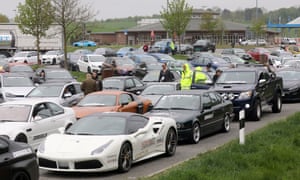
German police have seized 120 sports cars that were taking part in a suspected road race across Europe.
Cars including Porsches, Lamborghinis and Audis were stopped on Thursday on the A20 east of Wismar, in north-east Germany, on a stretch of the autobahn without speed restrictions.
Concerned drivers had notified authorities after some of the cars were witnessed travelling at estimated speeds of up to 155mph.
Most of the cars carried Norwegian licence plates and bore windshield stickers with the name of the event, Eurorally.

According to the Eurorally website, the event costs up to €799 to enter and consists of four legs, starting in Oslo and ending up in Prague. The second leg, on Thursday, took drivers from Kiel in Germany to Szczecin in Poland.
The website’s terms and conditions state that Eurorally is “not a competition” but merely a “holiday planner for car enthusiasts”.
“We aim to give you a once-in-a-lifetime experience holiday consisting of great events taking place in multiple countries along the route,” the website reads. “There will be parties at each destination, and at the final destination in Prague we will be hosting a farewell party where participants will be given awards in various categories.”

A spokesperson for Germany’s federal police told the newspaper Bild that authorities were investigating whether the event could be categorised as an illegal race.
Police set up stationary and mobile checkpoints along the rally’s planned route to watch for incidents of street racing, and also patrolled the roadway with a pair of helicopters. “A continuation [of the event] has definitely been stopped,” the spokesperson said.
This week, police stopped two other suspected races, in the west German cities of Duisburg and Krefeld. In Duisburg, two 22-year-old drivers had their licences confiscated after they were caught speeding through the streets at 80mph on Tuesday night.
Since you’re here…
… we have a small favour to ask. More people are reading and supporting our independent, investigative reporting than ever before. And unlike many news organisations, we have chosen an approach that allows us to keep our journalism accessible to all, regardless of where they live or what they can afford.
The Guardian is editorially independent, meaning we set our own agenda. Our journalism is free from commercial bias and not influenced by billionaire owners, politicians or shareholders. No one edits our editor. No one steers our opinion. This is important as it enables us to give a voice to those less heard, challenge the powerful and hold them to account. It’s what makes us different to so many others in the media, at a time when factual, honest reporting is critical.
Every contribution we receive from readers like you, big or small, goes directly into funding our journalism. This support enables us to keep working as we do – but we must maintain and build on it for every year to come.

No comments:
Post a Comment